The Cloud Era Of Feeling Untouchable
There was a time when spinning up an EC2 instance made me feel untouchable.
I learned AWS while working at GCash, but even that sentence feels too small for what it really was.
I got accepted into the GCash FinTech Engineer Cadetship Program and spent seven months being rebuilt from the ground up. It was not the kind of training where you passively sit through slides and pretend to absorb things. It felt more like being thrown into a room full of tools, systems, expectations, and sharp edges, then slowly realizing that this is what being an engineer actually demands of you.
We went through Linux, bash scripting, Java development, React development, and AWS. I still remember how wide everything felt back then. Every topic opened another door. Every door had three more behind it. It was exciting, but if I am being honest, it was also intimidating. There is a very specific feeling that comes with realizing how much you still do not know while trying your best to look composed in front of everyone else.
Part of the program was not just learning AWS, but proving we could survive it. We were tasked to take the AWS Solutions Architect Associate and AWS Developer Associate certifications, and I passed them. I remember the relief more than the pride. Relief that all those late nights, diagrams, service comparisons, and tiny details I kept forcing into my head had actually turned into something solid.
The First Lesson That Actually Stuck
My first AWS activity still sticks with me. We set up an S3 bucket to host a static site. It sounds simple now, almost cute, but at the time it felt like I had touched some hidden mechanism behind the internet.
Then came IAM, and with it one of the first ideas that really stayed with me:
just because you can give broad access does not mean you should.
Least privilege stopped feeling like a textbook principle and started feeling like discipline. After that came CloudFormation, bastion hosts, networking, and all the small choices that decide whether a system is clean, secure, and survivable or just barely standing.
That was the season where I started understanding that engineering is not just code. It is judgment. It is restraint. It is asking what should exist before asking how fast you can build it. AWS gave me that lens. It trained me to think about systems design first, to think about blast radius, access, maintainability, cost, and failure modes before racing to spill code onto a keyboard just to feel productive.
And for a while, that knowledge felt like magic. Open the console, click a few things, deploy an idea, watch it breathe. It felt like I had graduated into the real engineer version of myself. Not just writing code. Provisioning infrastructure. Naming instances like they were important. Pretending I was building the future.
Then I did what people do when a new tool makes them feel powerful. I started creating servers for every random idea that crossed my mind.
- A script here.
- A test project there.
- Something half-finished that I swore I would come back to next weekend.
I left some of them running all day, all night, all month.
Then the bill came.

$14.31 might not seem expensive for the most devs out there who are spending way more on AI tools, cloud resources. The thing is, I didn't even "use" the service it provisioned which is just an EC2 instance that I forgot to decommission.
I still remember the feeling of opening it and just staring. No dramatic lesson. No cinematic revelation. Just that sinking, embarrassed kind of silence when you realize you have been paying real money for machines doing almost nothing. It felt stupid in the most personal way because I knew better. Or at least I thought I did.
People love saying, "the cloud is just someone else's computer" and usually it sounds clever more than useful. This time it landed differently. Someone else's computer also means someone else's rules, someone else's meter, someone else's hand reaching into your wallet every month.
That was the moment I stopped romanticizing the cloud for problems that did not need it.
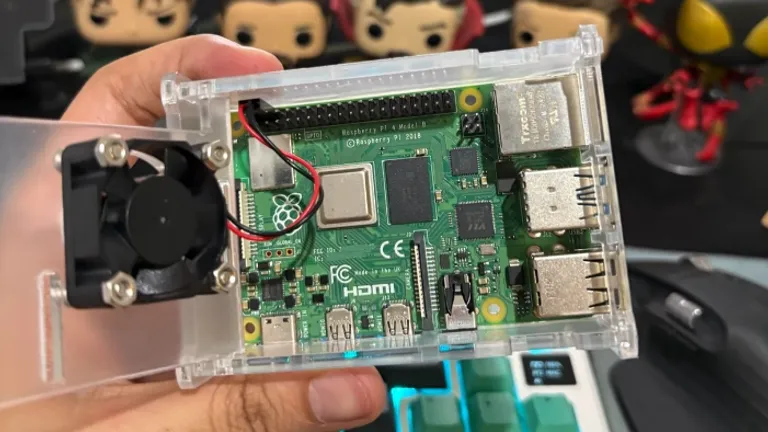
So I bought a Raspberry Pi 4B.
When it arrived, it did not feel like some grand technical milestone. It felt smaller than that, and somehow more honest. A little board on my desk, quiet and unpretentious, not trying to impress anyone. No dashboards. No pricing surprises. No fake feeling of infinite scale. Just a machine I could point at and say, this one is mine.
Right now it is doing real work for my upcoming Natural Language Processing course in my Master's in AI at The University of Texas at Austin.
I need a large dataset, and I knew I was not about to build that by manually collecting posts one by one like some kind of digital monk. So I wrote a Python scraper that lives on the Pi and keeps pulling data from X while I sleep. I wake up, check on it, and there is something deeply satisfying about seeing that tiny machine still there, still working, still gathering the raw material for the things I want to learn.
It is such a small shift, but it changed how I feel about building things.
With the Pi, I have been reading through Raspberry Pi OS docs, setting up Raspberry Pi Connect, and making sure I can SSH into it from anywhere. Nothing about the process felt flashy. Most of it was just me, a terminal, a handful of tabs, and the quiet relief of understanding my own setup a little more each night.
A Different Relationship With Experiments
I think that is the part I did not expect.
I did not just buy hardware.
I bought a different relationship with my experiments.
The cloud made it too easy for me to be careless. The Raspberry Pi makes me pay attention. It sits there in the corner like a gentle accusation and a second chance at the same time. If I want to run something 24/7, I can see exactly where it lives. If something breaks, I cannot hide behind abstraction. If it works, it feels earned.
Maybe this is my introduction to homelabbing.
Maybe this is also me getting a little less obsessed with looking like an engineer and a little more interested in actually building like one.
Either way, that tiny board on my desk has already taught me more than a few expensive cloud bills ever did.